
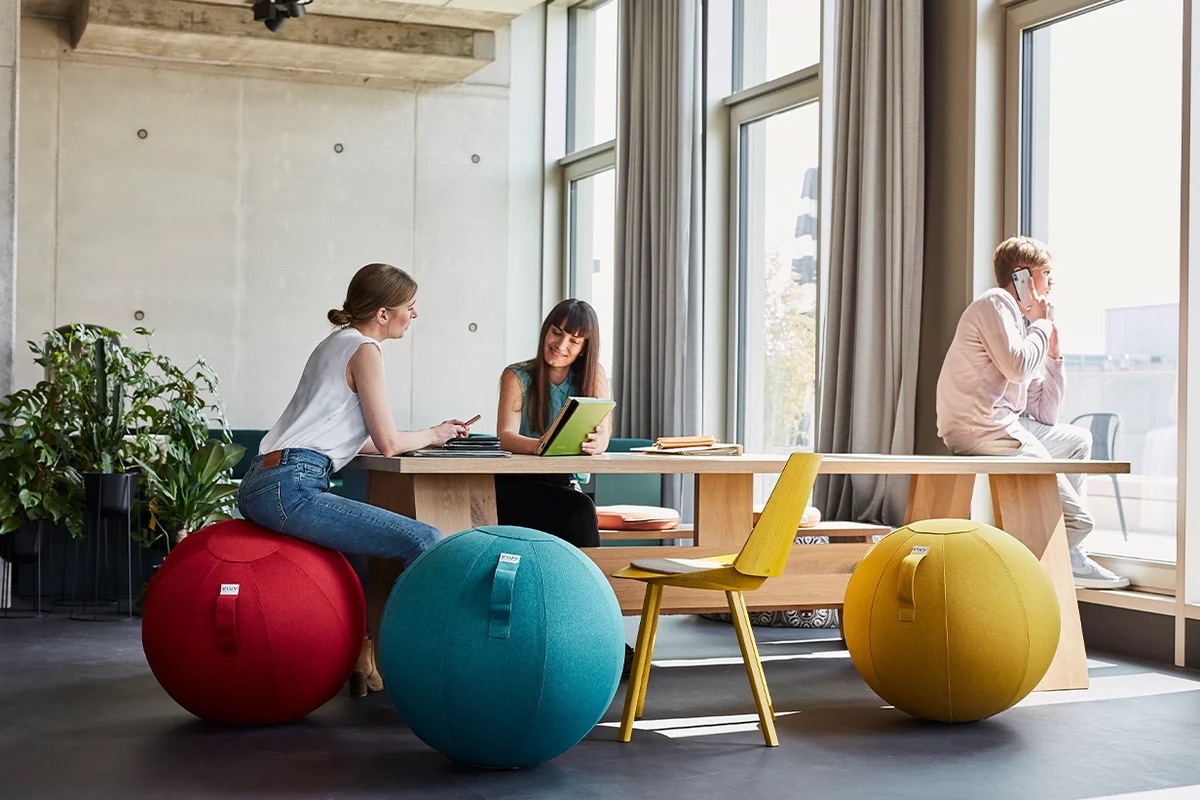
I see them more and more often in trendy offices or home workspaces: large, brightly coloured fitness / stability balls – a.k.a. yoga / fitness balls used as office chairs. The upholstered VLUV version – see above – are the trendiest. The theory is that sitting on an unstable surface forces your body to make small adjustments all the time, which is good for your back muscles.
That’s absolutely correct, but I’ve never actively recommended an ergonomic stability ball to anyone.
Why an ergonomic stability ball is usually NOT a good idea
In practice, there are quite a few risks associated with ergonomic sitting balls. Here’s why the ball often does more harm than good:
1. The ‘Core Paradox’
To sit properly on a ball, you need a strong core (your back and abdominal muscles). The problem? Most people don’t have that core stability. As soon as your muscles get tired — and that happens faster than you think — you slump. And that’s really bad for your posture.
2. Focus vs. Posture
When you are focused on your work, you forget about your body. Your brain prioritises your work, not balancing on a rubber ball. As soon as your focus is on your screen, your posture slips and you slip into harmful positions without even realising it.
3. The wrong height and lack of support
A crucial ergonomic point is the support of the arms and the angle of the knees.
- Too low: Most people sit far too low on a ball, which actually puts extra strain on the body.
- No arm support: When sitting (and moving) on a ball, it is difficult to find good support for your arms. This increases the risk of complaints in the neck, shoulders, upper back, arms, hands and wrists.
When an ergonomic stability ball IS a good idea
I sometimes talk to people who have developed a strong core through a lot of exercise and can sit on an ergonomic ball in a good posture in a natural way. Does it feel good? Then I would definitely continue to use it. However you sit, it is always very important to keep changing your posture. Make phone calls standing up and walk around regularly.
A fitness ball can help strengthen your back and abdominal muscles. But if you’re not a top athlete, I recommend doing that at the gym – not at work. Do you already have a ball like this at home or at your office workplace? Using a ball like this for 10-15 minutes for a change is usually fine – as long as you pay attention to your posture. But going for a walk is often healthier!
Academic research
- Over a prolonged period of sitting (one hour), no differences in trunk muscle activation patterns were observed, suggesting the ball does not aid in core strengthening. (University of Waterloo, 2016)
- Use an Exercise Ball for Exercise. Not as a Desk Chair (U.S. Army Public Health Center, various studies)
- There was no difference in muscle activation profiles across 14 muscles between sitting on the stool and ball, and calculated stability and compression values showed sitting on the ball made no difference in mean response values. (McGill, S.M., Kavcic, N.S., & Harvey, E, 2016)
- Use of stability balls at work decreases the likelihood of reporting pain from regular office chair use from approximately 45% to 21% (Schult et al., 2013)
AI Claude summarises the research done as follows: The weight of peer-reviewed evidence – particularly from the University of Waterloo’s Callaghan and McGill et al., the most rigorous work on this topic p- is that stability balls offer no meaningful ergonomic advantage and increase discomfort with prolonged use. Any short-term perceptual benefits (feeling more upright, more energised) are not matched by objective biomechanical measurements.