
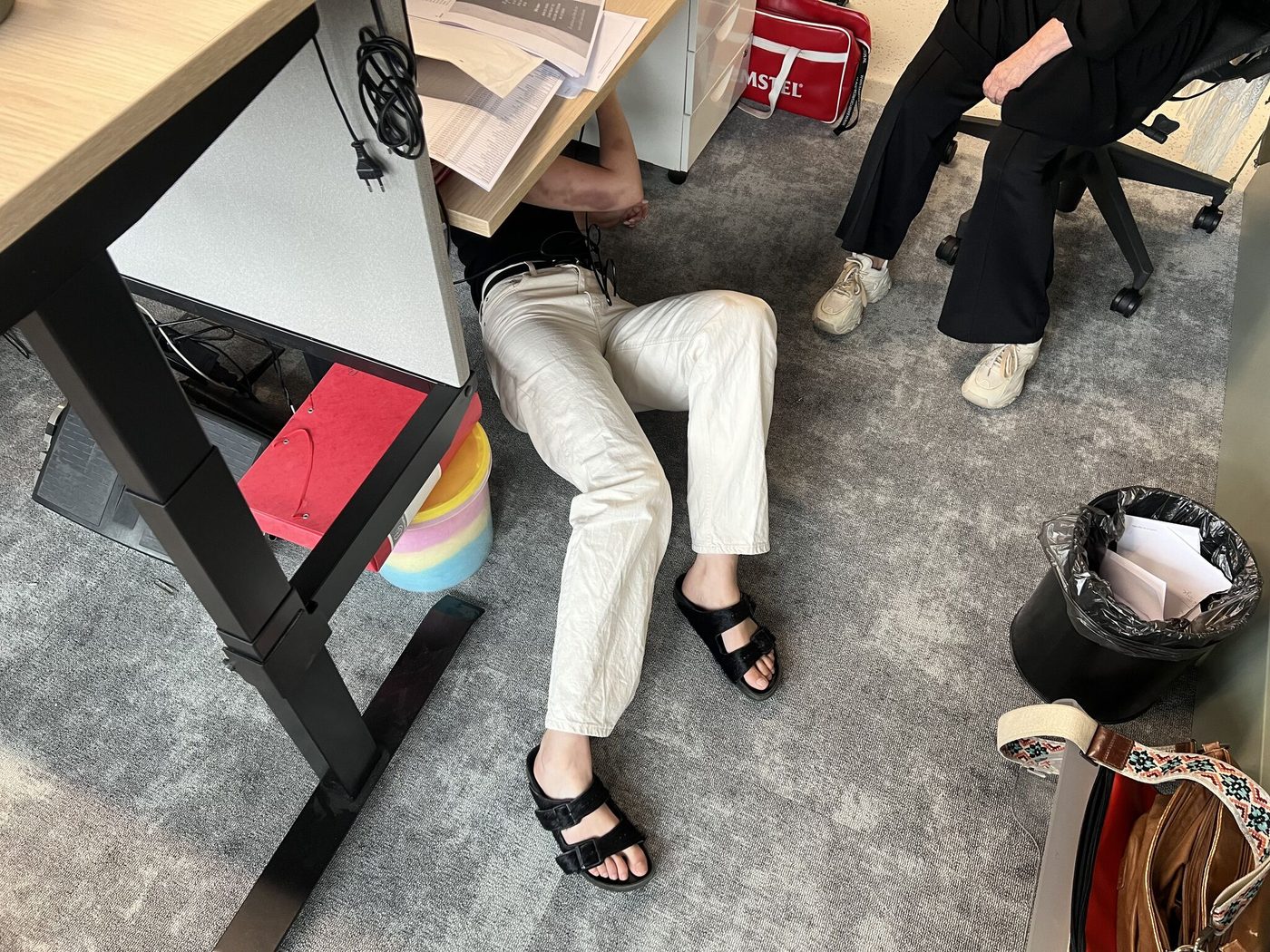
Unlike the prevention officer, the workplace ergonomics champion (in Dutch: “ergocoach”) is not a legally required role in The Netherlands. It’s a trained colleague who helps other staff “sit well” on the work floor. You’ll mostly find them in organisations with a lot of screen-based workers, such as offices and customer contact centres.
Many of my clients have a workplace champion, and I’m glad they do because they’re the “eyes and ears” that I can’t be, since I’m not at my clients’ offices every day. Workplace champions can add a lot of value. But not everywhere, and not for everyone.
What does a workplace ergonomics champion do?
A workplace champion has usually completed a short, practice-focused training course (not a medical or ergonomics qualification) and acts as an accessible first point of contact within the department. The main tasks:
- Spots obvious posture and workstation-setup issues on the work floor. For example, a screen that’s positioned too low, or a chair that’s never been adjusted.
- Helps colleagues set up their desk, chair and screen at the office
- Gives short, practical tips on sitting, standing and moving healthily during work.
- Is the first point of contact for workstation questions, without anyone needing to book an appointment.
- Refers people to an ergonomist as soon as a question or complaint falls outside their knowledge.
A workplace champion is genuinely useful
The big advantage of a workplace champion is their continuous presence on the work floor. Where an ergonomic office visit usually happens once a year for my clients, the workplace champion is around every single day. Small problems get spotted and fixed sooner this way, before they turn into actual complaints. It also has a knock-on effect: once one colleague sets up their workstation properly, others often follow suit. That makes a workplace champion a valuable addition to a one-off workstation assessment.
Only use a workplace champion in the office
I strongly advise clients against deploying a workplace champion for home workstations. In the office, the champion can physically look, measure and adjust things. With a home workstation, that view is completely missing – and almost every home situation is different again. The training focuses on a workstation where the chair and desk can be adjusted.
That difference is too big to cover with a short training course. On top of that, health and safety responsibility for home working works slightly differently than in the office, which calls for a more targeted approach. For home workers, an online workstation assessment is the better choice (which, again, is genuinely a specialism in its own right – and usually not part of the course).
Colleagues with complaints? Leave it to a specialist.
Pain in the neck, shoulders or back, or recurring RSI-type complaints? The workplace champion can flag problems, but doesn’t have a medical qualification and can’t realistically judge the underlying cause or what tailored solution is needed. That requires specialist knowledge from a properly trained ergonomist or occupational therapist.
Conclusion
A workplace ergonomics champion is strong at spotting issues, encouraging good habits and providing accessible help – in the office, for colleagues without complaints. As soon as it involves home workstations or actual complaints, more specialist knowledge is needed than a workplace champion can offer. Whoever combines both roles well – the workplace champion for day-to-day practice, a specialist for the exceptions – gets the most out of an ergonomic workplace policy.
Want to train or deploy a workplace champion within your office, or not sure where the line sits in your situation? I’m happy to think it through with you, without obligation.